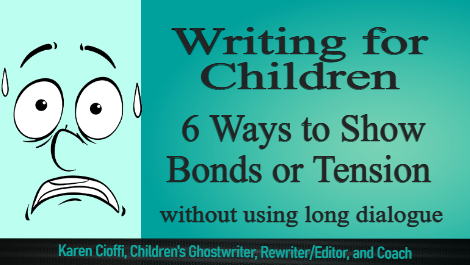
When writing a children’s story, it can be tempting to use dialogue to explain how characters feel about each other, to show character bonds or tension.
If two characters are close, they talk about their friendship. If they’re angry, they argue. If something is bothering them, they explain exactly what it is.
But real relationships don’t always work that way, and your characters don’t have to explain everything to the reader.
Some of the strongest bonds and tension can be shown through small actions, reactions, body language, and what characters choose not to say.
1. Use Small, Familiar Actions
One of the simplest ways to show a close relationship is through an action that has meaning between the characters.
-Your character might automatically save the last cookie for a sibling.
-A friend might notice that another child is nervous and quietly sit beside her.
-A mom might kiss her child’s cheek before he leaves for school.
You don’t need dialogue such as, “You’re my best friend, and I really care about you.”
The action shows it.
Think about what your characters know about each other.
Maybe one character always carries an extra pencil because her friend constantly forgets one. Maybe a child knows her younger brother is afraid and eases the fear by holding his hand.
These little details can make a relationship feel genuine without lengthy explanations.
2. Pay Attention to Body Language
Body language is another powerful way to show what a character is feeling.
A character who is comfortable with someone might lean against them, bump shoulders, steal a French fry, or walk beside them without feeling the need to talk.
Tension can be shown just as simply.
A character might cross their arms, avoid eye contact, turn away, grip the edge of a chair, or suddenly become very interested in something across the room. The character might also clench his teeth, tap a foot, or make a fist.
These all show suppressed anger or anxiety.
For younger readers especially, clear physical cues can help communicate emotions without explaining them.
Instead of: “I’m really angry with you,” Maya said.
You might show Maya shoving her chair back and refusing to look at her friend.
The reader can feel the tension without being told exactly how Maya feels.
3. Show What Characters Notice
Characters reveal their relationships through what they notice about one another.
-A child who cares about a friend may immediately notice that she isn’t wearing her favorite pink sneakers, ones that she wears every day.
-A sibling may recognize from one look that his brother is pretending to be fine.
That kind of observation can reveal familiarity and emotional connection.
Tension can work the same way.
A character might notice that someone is avoiding them, using a different tone of voice, being sarcastic, or sitting somewhere else at lunch.
Sometimes what a character notices—and what they don’t say about it—is more powerful than a long conversation.
4. Use Silence
Silence can say a lot.
If two close friends normally talk nonstop but suddenly have nothing to say to each other, the silence itself becomes meaningful.
Maybe one character asks, “Are you okay?”
The other responds, “Yep.”
And that’s it.
The short answer, especially if the reader knows the character is clearly not okay, can create more tension than a page of explanation.
Likewise, after an argument, two characters sitting together without speaking can show a relationship is strained but not necessarily broken.
5. Let Actions Contradict Words
One of my favorite ways to create emotional depth is to let a character’s actions contradict what they say.
“Basketball sign-up is in the gym, right now. Let’s sign up, Lucas said.
“Yeah, sure,” Jake muttered, dragging his feet so hard that his sneakers squeaked against the hallway floor.
That tells us much more than a paragraph explaining Jake’s conflicted feelings.
The same technique works for tension: “I’m not mad.”
But the character slams the door harder than necessary.
The contradiction gives the reader something to think about.
6. Less Can Be More
You don’t need long conversations to establish a strong bond or create tension between characters. Often, a glance, a gesture, a familiar habit, a moment of silence, or a small act of kindness can do the job more effectively.
When revising your manuscript, look for places where your characters explain feelings that could instead be shown through behavior or body language.
Ask yourself: Could this emotion be shown instead of spoken?
If the answer is yes, try replacing some of the dialogue with an action, reaction, observation, or moment of silence.
Your characters may say less—but your readers will understand more.
Summing It Up
Strong relationships and believable tension often live in the little moments. It could be the look a character gives, the favor they do without being asked, the space they put between themselves and someone else, or the words they choose not to say.
As you write, look beyond dialogue for these opportunities. Showing rather than explaining not only keeps your story moving but also gives young readers the chance to notice the clues, understand the characters, and experience the emotions for themselves.

I’m a working children’s ghostwriter, book doctor, editor, and self-publishing consultant. I help turn your idea, outline, or manuscript into a book you’ll be proud to call your own—and provide hands-on guidance through every step of the self-publishing process.
OTHER HELP I OFFER:
HOW TO WRITE A CHILDREN’S FICTION BOOK
A 200+ page book that will help you write your own children’s book.
CHILDREN’S PICTURE BOOK AND CHAPTER BOOK COACHING
4- to 12-week programs
WRITERS ON THE MOVE SELF-PUBLISHING GUIDANCE & SERVICES
Guidance and more for children’s authors (specializing in picture books and chapter books)
You can contact me at kcioffiventrice@gmail.com.