Writing historical fiction can be challenging. You must tell a story and convincingly recreate a bygone time and culture that readers must believe in.

When done well, historical fiction transports readers into another era. Done poorly, it loses credibility and readers quickly.

If you’re writing historical fiction, it’s essential to be aware of common pitfalls.

The following are 10 pitfalls that frequently arise, along with tips for navigating each.

1. Not Doing Your Homework

One of the biggest mistakes writers make is ignoring historical accuracy or not doing enough research.

Readers of historical fiction expect authenticity. If your story is set in the 1800s and your characters use modern slang or technology that didn’t exist yet, it immediately breaks the illusion.

While you don’t need to be a historian, you do need to understand the era’s essentials: clothing, customs, transportation, food, and social norms.

2. Overloading the Story with Research

While you want historical accuracy, the opposite mistake is also common. Some writers include every piece of research they discovered. This can slow the story down and overwhelm readers with unnecessary information.

Remember, historical details should support the story, not replace it. Use only what helps move the plot forward or deepen the setting.

Your main goal should be to write an engaging story.

3. Writing Characters with Modern Mindsets

Characters should reflect the beliefs and attitudes of their time. Giving them modern perspectives can make the story feel unrealistic.

Keep in mind that people in earlier centuries had very different views about gender roles, politics, religion, and a social hierarchy. Your characters may question those ideas, but their worldview should still feel rooted in the time period.

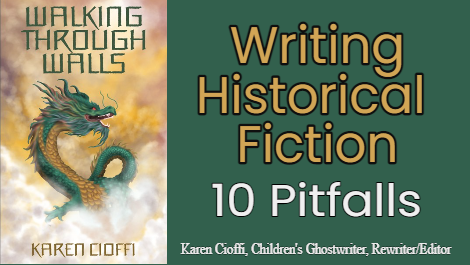
In my children’s chapter book, “Walking Through Walls,” set in 16th-century China, I layered the story and the protagonist, Wang, with period-appropriate respect.

4. Using Modern Language and Expressions

Dialogue is one of the quickest ways to break historical authenticity. Phrases like “no problem,” “hang out,” or “cool” can feel out of place in certain historical settings.

You don’t need to mimic archaic speech perfectly, but the tone and vocabulary should match the era. Aim for language that feels natural while still reflecting the period.

Using “Walking Through Walls” as an example again, I eliminated all contractions in the dialogue and layered it with respect.

5. Forgetting the Sensory Details

Historical fiction should immerse readers in the past world. Avoid vague descriptions that could belong to any period.

Instead, include sensory details that reflect the era, like horse hooves on cobblestone streets, the smell of wood fires, candlelight flickering in a window, or the sounds of a busy marketplace.

For example, Wang had been away for a year and just returned home.

“Wang ran through the fields. The wheat brushed against him as he raced through the rows. A familiar sensation flowed through his body. He forgot the brushing sound the wheat stalks made as he passed by, the fragrance they emitted, and even the taste that occasionally made its way into his mouth when binding up the cut stalks, or on a windy day.”

These details help readers feel as if they’re in the wheat fields with Wang.

6. Making the Setting Feel Like a Backdrop

In historical fiction, the setting should play an active role in the story. It shouldn’t feel like a painted background behind modern characters.

The historical period should shape how people live, dress, travel, communicate, and solve problems.

For example, without modern transportation or instant communication, characters must rely on slower methods that naturally affect the plot.

An example of the setting affecting the story: “Tired and hungry, Wang trudged through fog thick as porridge. ‘Seven days and nothing. I cannot even see where I am going. Will I ever find those elusive Eternals?’ he muttered.”

Wang didn’t have a horse or mule and had no other means of transportation aside from walking. This adds time to the story and events that happen on the trail.

7. Including Historical Events Without Purpose

Many writers feel obligated to include famous historical events, but they should do so only if they serve the story.

Forcing major events into the plot can feel unnatural. Instead, show how the period shapes the characters’ lives. Sometimes, smaller, everyday experiences reveal more about history than big events do.

8. Creating Perfect Historical Heroes

Real people in history were complicated. Avoid making characters too perfect or idealized.

As with all genres, flawed characters are more believable and engaging. They should struggle with fears, doubts, and difficult choices, just like people do today.

These imperfections also help readers connect emotionally with the story.

9. Neglecting Cultural and Social Context

Historical societies often had strict social structures and cultural expectations. Ignoring these realities can weaken the authenticity of your story.

For instance, social class, family reputation, gender expectations, and community rules often shaped people’s opportunities and decisions. Understanding these factors will make your characters’ actions feel more believable.

10. Letting History Overshadow the Story

Remember that historical fiction is still fiction. The story should always come first.

Readers choose novels for compelling characters, conflict, and emotional journeys—not just historical information. The best historical fiction blends accurate details with engaging storytelling so readers learn about the past while enjoying a powerful narrative.

SUMMING IT UP

I enjoy writing historical fiction, but it requires a careful balance between research and storytelling. Too little detail can make the story feel unrealistic, but too much can slow the narrative.

Focus on creating believable characters who live naturally within their historical world. When you blend accurate details with strong storytelling, you can transport readers into the past and make history come alive.

Steering clear of these common pitfalls will help ensure your historical fiction stays authentic, engaging, and memorable. Thorough research, believable characters, era-appropriate elements, including language, and an active setting are key qualities for success in the genre.

Historical Fiction: 10 Tips to Bring the Past to Life

Proofreading – The Final Frontier

A Guide to Writing a Relatable Children’s Story

I’m a working children’s ghostwriter, rewriter/editor. I can help turn your idea, outline, or manuscript into a book you’ll be proud to be the author of, one that’s publishable and marketable.
OTHER HELP I OFFER:
HOW TO WRITE A CHILDREN’S FICTION BOOK
A 200+ book that will help you write your own children’s book.
FICTION WRITING FOR CHILDREN eCOURSE
4, 8, or 12 Weeks / 9 Sections / Instructor Guided Self-Study Program
WRITERS ON THE MOVE SELF-PUBLISHING SERVICE
Self-publishing help for children’s authors (picture books and chapter books)
You can contact me at kcioffiventrice@gmail.com.

1 thought on “Writing Historical Fiction: 10 Pitfalls”